
Computing flows and interpreting their physics
We develop and apply numerical methods for complex flows and analysis methods that extract physical meaning from simulation results. The focus is on the phenomena a method represents and the questions it can answer.
- DNS, LES, hybrid RANS/LES, and turbulence modeling
- Curvilinear coordinates and immersed boundary methods for complex geometries
- Interface tracking in multiphase flows and lattice Boltzmann methods
- MPI/OpenMP parallel computing and turbulence simulation codes
- Detection of turbulent structures and interfaces, and physically constrained modal analysis
Physical modeling and flow analysis
We detect turbulent/non-turbulent interfaces and large-scale structures and connect flow statistics with dynamics. Our 2025 square-cylinder wake paper introduces physics-regulated dynamic mode decomposition (DMD). Learning-based turbulence-model research is presented in terms of its target flow and physical interpretation.
Extensions to multiphysics problems
Our analysis experience extends to CMP slurry transport, hydrogen dispersion, optical resonance, and heat redistribution. See Multiphysics Applications for these examples.
Related publications · Public research record
Comparing simulation methods
A 2024 elbow-flow study compared RANS and LBM with DNS to examine unsteady vortical structures. A 2025 compressor-noise study used VLES/LBM for flow and noise analysis. Conference summaries and credited students are linked in the publications and presentations lists.
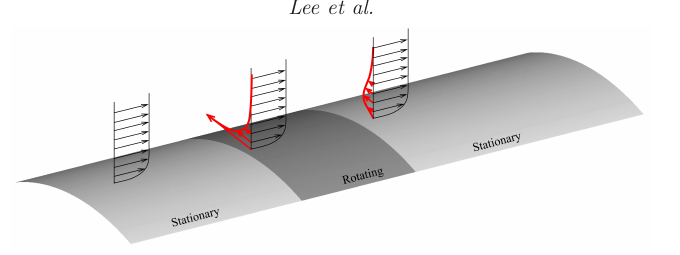
Lee et al., Stanford CTR Summer Program 2018, Fig. 1. Stationary–rotating–stationary cylinder configuration.